Grids
Overview
Grids are similar to tiles. Both tiles and grids allow elements to fluidly adjust depending on available space. Grids lay out its elements using externally supplied normalized fractional coordinates that specify positions of the elements in the allocated space.
Grids are best for composing tables.
Horizontal Grids
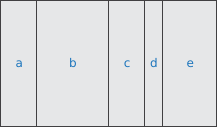
Horizontal Grids are composites that lay out one or more child elements in a row following externally supplied horizontal fractional positions. Horizontal Grids have computed horizontal and vertical sizes following the natural limits of its children.
Semantics
-
The elements are laid out in a single row, left to right, immediately next to each other with no intervening space.
-
The elements are positioned horizontally using the supplied fractional positions. The fractional positions values range from 0.0 to 1.0, which specify the child element’s horizontal position from left (0.0) to right (1.0).
-
The grid’s minimum vertical limit is computed as the maximum of the children elements' minimum vertical limits.
-
The grid’s maximum vertical limit is computed as the minimum of the children elements' maximum vertical limits.
-
The final computed minimum limit is clamped to ensure it is not greater than the computed maximum limit. Likewise the computed maximum limit is clamped to ensure it is not less than the computed minimum limit.
-
The supplied (horizontal) positions and computed (vertical) coordinates may violate the limits of its children elements.
-
If the allocated size of a child element is lower than the element’s minimum limits in either dimension, the element will be cropped.
-
If a child element’s maximum limits in either dimension is exceeded, the element will be aligned to the top-left.
-
hgrid
Build a horizontal grid with a fixed number of elements.
Notation
N-
The number of items
e1,...eN-
One or more child elements, instances of
Element(more below) positions-
External container of fractional positions (more below)
The external container, positions, can either be a plain array of type
float[N] or std::array<float, N>. Elements e1,...eN are held in a
std::array<element_ptr, N> managed by the horizontal grid element.
Example
static float positions[] = {0.25, 0.5, 0.75, 1.0};
//...
hgrid(positions, item1, item2, item3, item4)
If the number of elements is not fixed, you can use an
hgrid_composite (see below).
|
Requirements
-
The number of supplied positions and elements, multiplied by each element’s span, should match, otherwise, undefined behavior. By default elements have a span of
1. See Span Element for more information. -
The positions assume the first element is at
x=0(it is at the left-most position in the row). The fractional position of the second element is at index0, the third at index1, and so on. -
The externally supplied positions should be sorted with increasing values such that positions[n] <= positions[n+1]. The behavior is undefined if this is violated.
hgrid_composite
Create a horizontal grid with an indeterminate (dynamic) number of elements.
Notation
positions-
External container of fractional positions,
std::vector<float> c-
Instance of type
hgrid_composite
The hgrid_composite is essentially a std::vector<element_ptr> that the
client uses to manage the composite’s elements. The client is responsible for
the lifetime of the container, c. You can use hgrid_composite in the same
way as a std::vector, such as using push_back to add a child element.
Remember that the items are element_ptr instances.
Example
c.push_back(share(child));
share turns an element object into an element_ptr held by
the std::vector<element_ptr> in hgrid_composite.
|
hgrid_composite is itself also an element and while it has std::vector's
interface, it can also be shared like any element, which allows you to
build complex hierarchical structures.
Requirements
-
The number of items in the external coordinates vector
positionsmust match with the number of elements at any given time. -
The positions assume the first element is at
x=0(it is at the left-most position in the row). The fractional position of the second element is at index0, the third at index1, and so on. -
The externally supplied positions should be sorted with increasing values such that positions[n] <= positions[n+1]. The behavior is undefined if this is violated.
Vertical Grids
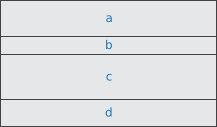
Vertical Grids are composites that lay out one or more child elements in a column following externally supplied vertical fractional positions. Vertical Grids have computed horizontal and vertical sizes following the natural limits of its children.
Semantics
-
The elements are laid out in a single column, top to bottom, immediately next to each other with no intervening space.
-
The elements are positioned vertically using the supplied fractional positions. The fractional positions values range from 0.0 to 1.0, which specify the child element’s vertical position from top (0.0) to bottom (1.0).
-
The grid’s minimum horizontal limit is computed as the maximum of the children elements' minimum horizontal limits.
-
The grid’s maximum horizontal limit is computed as the minumum of the children elements' maximum horizontal limits.
-
The final computed minimum limit is clamped to ensure it is not greater than the computed maximum limit. Likewise the computed maximum limit is clamped to ensure it is not less than the computed minimum limit.
-
The supplied (vertical) positions and computed (horizontal) coordinates may violate the limits of its children elements.
-
If the allocated size of a child element is lower than the element’s minimum limits in either dimension, the element will be cropped.
-
If a child element’s maximum limits in either dimension is exceeded, the element will be aligned to the top-left.
-
vgrid
Build a vertical grid with a fixed number of elements.
Notation
N-
The number of items
e1,...eN-
One or more child elements, instances of
Element(more below) positions-
External container of fractional positions (more below)
The external container, positions, can either be a plain array of type float[N] or std::array<float, N>. Elements e1,...eN are held in a std::array<element_ptr, N> managed by the vertical grid element.
Example
static float positions[] = {0.25, 0.5, 0.75, 1.0};
//...
vgrid(positions, item1, item2, item3, item4)
If the number of elements is not fixed, you can use an
vgrid_composite (see below).
|
Requirements
-
The number of supplied positions and elements, multiplied by each element’s span, should match, otherwise, undefined behavior. By default elements have a span of
1. See Span Element for more information. -
The positions assume the first element is at
x=0(it is at the top-most position in the column). The fractional position of the second element is at index0, the third at index1, and so on. -
The externally supplied positions should be sorted with increasing values such that positions[n] <= positions[n+1]. The behavior is undefined if this is violated.
vgrid_composite
Create a vertical grid with an indeterminate (dynamic) number of elements.
Notation
positions-
External container of fractional positions,
std::vector<float> c-
Instance of type
vgrid_composite
The vgrid_composite is essentially a std::vector<element_ptr> that the
client uses to manage the composite’s elements. The client is responsible for
the lifetime of the container, c. You can use vgrid_composite in the same
way as a std::vector, such as using push_back to add a child element.
Remember that the items are element_ptr instances.
Example:
c.push_back(share(child));
share turns an element object into an element_ptr held by
the std::vector<element_ptr> in vgrid_composite.
|
vgrid_composite is itself also an element and while it has std::vector's
interface, it can also be shared like any element, which allows you to
build complex hierarchical structures.
Requirements
-
The number of items in the external coordinates vector
positionsmust match with the number of elements at any given time. -
The positions assume the first element is at
x=0(it is at the top-most position in the column). The fractional position of the second element is at index0, the third at index1, and so on. -
The externally supplied positions should be sorted with increasing values such that positions[n] <= positions[n+1]. The behavior is undefined if this is violated.
Copyright (c) 2014-2024 Joel de Guzman. All rights reserved. Distributed under the MIT License