Edge Detectors
Overview
rising_edge and falling_edge turn a boolean signal into single-sample events. A rising_edge returns 1 on the one sample where its input transitions from 0 to 1, and 0 everywhere else. A falling_edge is its mirror: it returns 1 on the transition from 1 to 0. Both hold the previous input in a single bool of state, so a steady input, whether high or low, produces no output; only the change is reported.
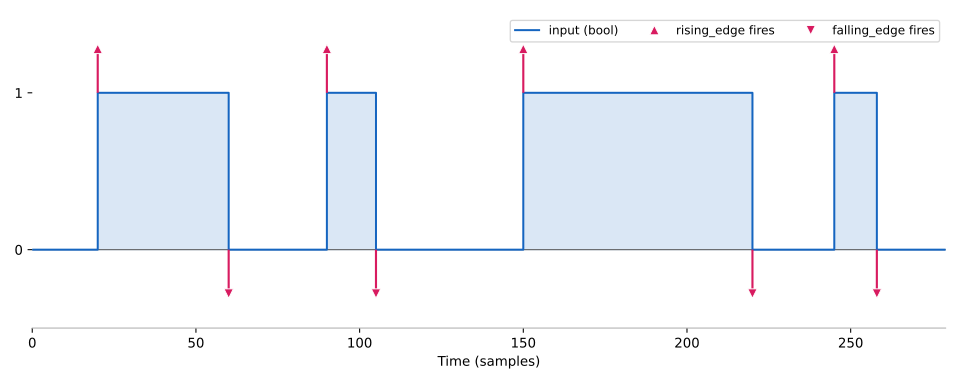
rising_edge firing on each 0 to 1 transition and falling_edge firing on each 1 to 0 transition. Each fire is a single-sample event; the steady stretches in between produce nothing.These are the natural companions to the comparators. A Schmitt Trigger, Window Comparator, or a plain threshold test yields a boolean that stays latched for as long as the condition holds; feeding that boolean through a rising_edge isolates the instant it first went true; a trigger, a counter, or a one-shot such as the Monostable takes that instant. Both detectors are constexpr.
Declaration
struct rising_edge
{
   constexpr bool    operator()(bool val);
   bool              _state = 0;
};

struct falling_edge
{
   constexpr bool    operator()(bool val);
   bool              _state = 0;
};
Expressions
In addition to the expressions below, rising_edge and falling_edge are default constructible and copy constructible.
Function Call
| Expression | Semantics | Return Type |
|---|---|---|
|
Return |
|
|
Return |
|
State is held in the public member _state, the last input seen. A freshly constructed detector starts with _state == 0, so a first call with val == 1 reports a rising edge (and, symmetrically, a first val == 0 reports no falling edge).
|