Bitset
Overview
bitset is a fixed-size array of bits packed into machine words. The size is fixed at construction: you ask for a number of bits, and the storage rounds up to a whole number of words. It is small and direct, built for raw word access, so an algorithm can process the bits a whole word at a time; it does not replace std::bitset or std::vector<bool>.
Bits are stored in a std::vector of unsigned integers of type T (default natural_uint, the widest native unsigned word, 64 bits on a 64-bit target). Bit i lives in word i / value_size at position i % value_size, least significant bit first, where value_size is the number of bits in one word.
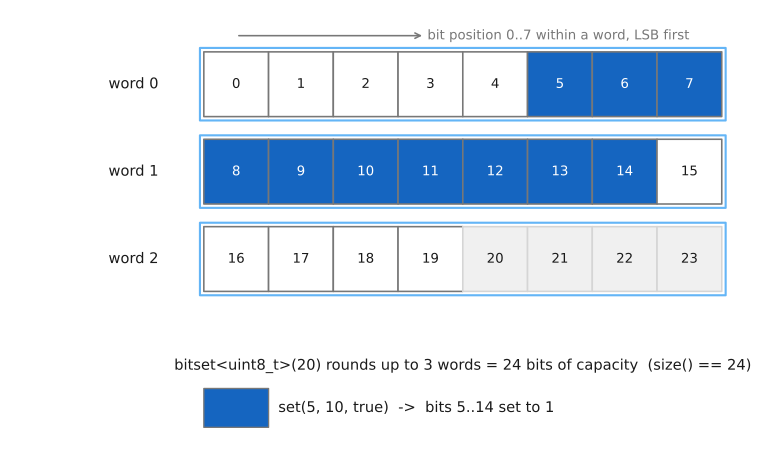
The class provides four things: set a single bit, set a contiguous range of bits, get a single bit, and clear everything to zero. The range set is the interesting one: it writes the leading partial word, then whole words value_size bits at a time, then the trailing partial word, so filling a long run is far cheaper than a bit-at-a-time loop.
data() hands back the underlying word pointer. For that reason bitset is the storage behind the Bitstream Autocorrelation (Bitstream Autocorrelation), where the correlation runs by XOR plus population count over the raw 64-bit words. A one-bit quantization of the signal is packed into a bitset and correlated word-wise, and the BACF is O(N) for it.
size() reports capacity in bits (words times value_size), which may be larger than the number of bits requested at construction, because the storage rounds up to a whole word. In the figure, bitset<uint8_t>(20) reports size() == 24.
|
Valid bit indices are 0 ⇐ i < size(). T must be an unsigned type (enforced by a static_assert).
|
Declaration
template <typename T = natural_uint>
class bitset
{
public:

   using value_type = T;
   using vector_type = std::vector<T>;

   static constexpr auto value_size = CHAR_BIT * sizeof(T);

                  bitset(std::size_t num_bits);
                  bitset(bitset const& rhs) = default;
                  bitset(bitset&& rhs) = default;

   bitset&        operator=(bitset const& rhs) = default;
   bitset&        operator=(bitset&& rhs) = default;

   std::size_t    size() const;
   void           clear();
   void           set(std::size_t i, bool val);
   void           set(std::size_t i, std::size_t n, bool val);
   bool           get(std::size_t i) const;

   T*             data();
   T const*       data() const;
};
Expressions
Notation
T-
The unsigned word type. Defaults to
natural_uint. b-
An object of type
bitset<T>. num_bits-
The number of bits requested, a
std::size_t. i-
A bit index, a
std::size_t. n-
A count of bits, a
std::size_t. val-
A
bool: the value to write.
Type Definitions
| Expression | Semantics | Type |
|---|---|---|
|
The word type. |
|
|
The underlying storage type. |
|
|
Bits per word ( |
|
Constructors
| Expression | Semantics |
|---|---|
|
Construct storage for at least |
|
Copy construct from |
With the default T, the shorthand bitset (no template argument) uses natural_uint words.
|
Function Call
| Expression | Semantics | Return Type |
|---|---|---|
|
Capacity in bits: |
|
|
Set every bit to 0. |
|
|
Set the single bit at index |
|
|
Set the |
|
|
Get the bit at index |
|
|
Pointer to the first storage word (mutable or |
|
Example
Quantize a block of samples to a one-bit stream, one bit per sample, then hand the raw words to a word-wise consumer (the pattern the BACF uses):
q::bitset<> bits(block.size());       // natural_uint (64-bit) words
for (auto i = 0u; i != block.size(); ++i)
   bits.set(i, block[i] > 0.0f);       // sign bit of each sample

// Process the packed bits a whole word at a time.
auto const* words = bits.data();
auto n_words = bits.size() / bits.value_size;
Set a contiguous range in one call, which fills whole words internally rather than looping bit by bit:
q::bitset<> mask(256);
mask.set(64, 128, true);              // turn on bits 64..191
mask.clear();                          // back to all zeros