Dynamic
Overview
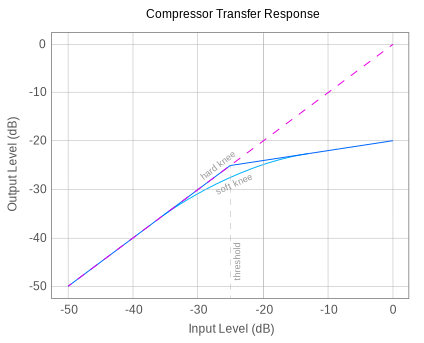 Audio dynamic range processing DSP refers to the manipulation of an audio signal’s dynamic range. The dynamic range of an audio signal is the difference between its loudest and quietest components. Compression, Expansion, Limiting, and Gating are a few common types of dynamic range processing used in audio DSP. Such processing can enhance sound quality, minimize or eliminate noise, and create creative effects.
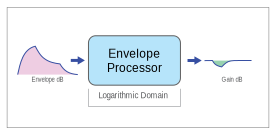
The dynamic range processors in the Q DSP library are unique in that they do not process audio waveform samples directly. Instead, they operate on the envelope of the audio signal, represented as decibel, perform computations in the logarithmic domain, and return the gain, also represented as decibel:
Dynamic Range Processors
-
Compressor: reduces the level of signals above the threshold.
-
Soft Knee Compressor: a compressor whose ratio changes gradually around the threshold.
-
Expander: reduces the level of signals below the threshold.
-
AGC: raises or lowers the gain to hold the output at a reference level.
Key Points
-
The code in the Example below accepts an envelope input,
env, in decibels and outputs the compressed gain also in decibels. -
Processing is done in the logarithmic domain, where addition of two values is equivalent to multiplying their corresponding linear values, and multiplication of two values is equivalent to raising their corresponding linear values to a power.
-
The envelope follower, which is responsible for generating the input envelope for the compressor, is implemented outside of the compressor class. The objective is separation of concerns and the flexibility to use various envelope followers.
-
Compared to their linear counterparts, performing computations in the logarithmic domain is simpler, more intuitive, and makes the code easier to understand while maintaining the same level of efficiency.
-
The compressor example below and all dynamic range processors in the Q DSP library are essentially envelope processors. They receive envelopes, process envelopes, and return the gain in decibels.
Cascading
Since envelope processors operate on the envelope, perform computations in the logarithmic domain, and return the computed gain, multiple envelope processors can logically be cascaded. For instance, you can use a single envelope follower and apply the derived envelope to both an expander and a compressor. Since we are working in the logarithmic domain, cascading is simply summing the outputs of the processors, keeping in mind that summation in the decibel domain is equivalent to multiplication in the linear domain. Example:
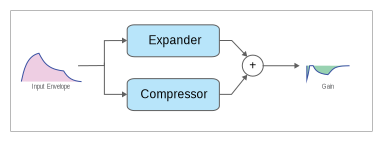
A specific use-case for cascading an expander and a compressor, like in the example above, is when you want to use the expander as a noise gate, with soft, non-abrupt gating, set at a threshold just above the noise floor. Then, setting the threshold of the compressor to a high value to even out the dynamic range.
If there’s an overlap, you can use the maximum (or minimum) of the outputs using std::max (or std::min) instead of adding the outputs.
|
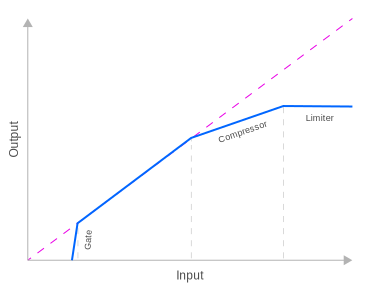 The compressor and expander in this case work on different regions of the full dynamic range. But there are also useful cases where the overlap of dynamic ranges the processors are working on is advantageous. The compressor-limiter is a good example. Likewise, multiple compressors with variable thresholds and ratios are another example.
By cascading multiple dynamic range processors, we can design efficient multi-function processors like the compressor-limiter with gate (transfer response graph at the right).
Example
As an example, here’s the processing code for the compressor:
decibel compressor::operator()(decibel env) const
{
   if (env <= _threshold)
      return 0_dB;
   return _slope * (_threshold - env);
}| This is a hard knee compressor: a type of compressor in which the compression ratio changes abruptly when the input signal exceeds the threshold level, known as the knee point. Both hard knee and soft knee compressors are supported by the Q DSP library. |