FM Synth
Overview
example/fm_synth/fm_synth.cpp plays four of the DX7’s factory patches
through Q’s FM engine. It is the shortest path from a patch to a sound: a
DX Patcher compiles a patch once, a pool of FM Voice plays it, and the
four clips the FM Synthesis page plays are what
it writes.
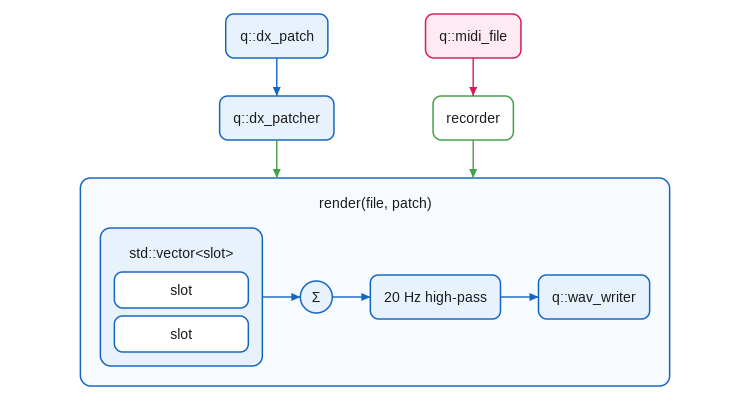
-
DX Patcher compiles the patch once for the sample rate, and every slot plays from that one compiled copy.
-
A slot holds an FM Voice, its
phase_iterator, and when it was last played, which is what voice stealing goes by. -
The sum passes a 20 Hz high-pass, as the instrument’s output stage does.
-
Each clip is brought to the same peak before it is written.
Everything around the voice is what the Virtual Analog Synth left: a pool, a note taking a voice, a MIDI file for the notes. The voice itself is built the other way around. There, a patch was a handful of panel settings a voice read directly, and the sound came of taking harmonics away from a rich waveform. Here a patch is six operators in DX7 units, compiling it is a step of its own, and the harmonics are built rather than removed.
The Patch
A dx_patch is the numbers a DX7’s panel shows, operator by operator: output
level, frequency ratio, detune, the four rates and levels of its envelope,
then keyboard scaling and the sensitivities.
q::dx_patcher::config epiano_1()
{
   return
   {
      {  // OP1 to OP6: level, fixed, coarse, fine, detune, the
         // envelope, then the keyboard scaling and sensitivities
         {99, false,  1,  0, 10, {{96,25,25,67}, {99,75, 0, 0}},
             0,  0,  0, 0, 0, 3, 0, 2},
         // ... OP2 to OP6
      },
      {{94,67,95,60}, {50,50,50,50}},     // the pitch envelope
      {5, 6},                             // algorithm, feedback
      {34, 33, false, 4},                 // the LFO
      0, 0, 3,                            // LFO depths and sensitivity
      false, 24,                          // oscillator key sync, transpose
      "E.PIANO 1"
   };
}
Nothing in a patch is in seconds or hertz: rate 96 and level 99 are what the panel reads, and turning them into an envelope and a frequency is the patcher’s job. See DX Patcher for what each number means.
Compiling a Patch
A DX Patcher takes a patch and a sample rate and works out, once, what an FM Voice needs: the voice’s configuration and, per operator, what each key plays. Every voice in the pool shares one compiled patch.
auto patcher = std::make_shared<q::dx_patcher const>(cfg, sps);
std::vector<slot> pool;
pool.reserve(voices);
for (std::size_t i = 0; i != voices; ++i)
   pool.emplace_back(patcher);
A voice is then the patch plus the phase it is played at. The pitch is the caller’s, as it is for every oscillator in Q:
void attack(std::uint8_t key_, float velocity, std::uint64_t order_)
{
   key = key_;
   order = order_;
   master.set(q::frequency{440.0 * std::pow(2.0, (key - 69) / 12.0)}, sps);
   voice.attack(*patch, key, velocity);
}
Playing a MIDI File
The notes come from `q::midi_file`, which plays a standard MIDI file into a processor with each message timed in samples. The Virtual Analog Synth covers that side in full; the recorder here is the same.
Voices are taken free first, and the oldest is stolen when all are busy:
auto free = std::find_if(pool.begin(), pool.end(),
   [](auto const& s) { return !s.voice.active(); });
auto& s = free != pool.end()? *free
   : *std::min_element(pool.begin(), pool.end(),
      [](auto const& a, auto const& b)
      { return a.order < b.order; });   // steal the oldest
s.attack(e.key, e.velocity, ++order);
Knowing When to Stop
Rendering to a file needs an end, and a DX7 patch does not always give one: an envelope whose final level is above zero never dies away. The render therefore stops when every voice has gone quiet, or when the tail runs out, whichever comes first:
if (next == rec.events.size())
{
   if (!sounding)
      break;
   if (i > rec.events.back().time + std::size_t(tail * sps))
      break;
}
A last touch is the output stage: a 20 Hz one-pole high-pass, as the instrument has, which takes the rumble a stack of voices can accumulate.
The four clips are each brought to the same peak. The patches' own levels are more than 20 dB apart, BASS 1 being the quietest of these and BRASS 1 the loudest, which is how the instrument ships them.
Running
cmake -B build
cmake --build build --target example_fm_synth
build/example/fm_synth/example_fm_synth
With no argument the four clips play in turn through the default output device. Given a directory, they are written there as WAV files instead:
build/example/fm_synth/example_fm_synth ~/clipsComponents Used
| Component | Role |
|---|---|
Compiles a patch in DX7 units for the sample rate |
|
One voice, six operators under an algorithm |
|
The operator each voice is built from |
|
How the operators are wired |
|
The rate and level envelope every operator carries |
|
The pitch, which the voice is given |
|
The notes, read from a standard MIDI file |
|
|
|
Playing through the default output device |
Previous: Virtual Analog Synth | Next: Grain Freeze