Grain
Overview
A grain is a windowed read tap over a ring buffer, playing at rate 1. It is
spawned at a fixed delay, possibly fractional, and for the next width
samples it outputs window × buffer[delay], then goes inactive. The grain is
implemented by a class template named grain.
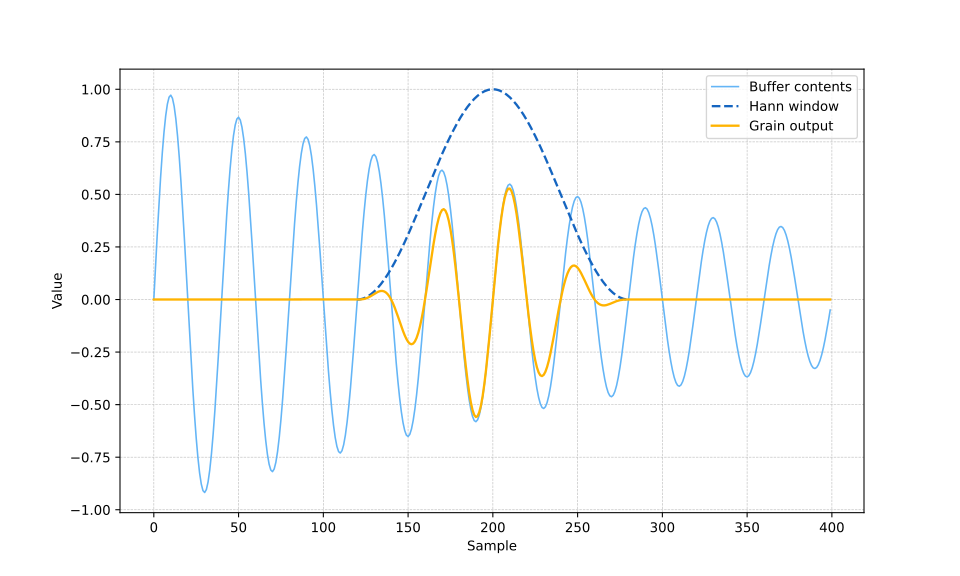
The delay stays constant for the grain’s lifetime. The buffer indexes newest first, so a constant delay advances through the signal at the write rate: playback at rate 1, with no per-sample position arithmetic.
A grain does not resample. It plays its slice of the buffer at the original rate, so its output keeps the original spectral content. Re-pitching, time stretching, freezing and sustaining come from the scheduler: when grains are spawned and where they are anchored. This preserves the formants in pitch-synchronous overlap-add (PSOLA): the scheduler changes the spacing of the grains, and their content stays as it is.
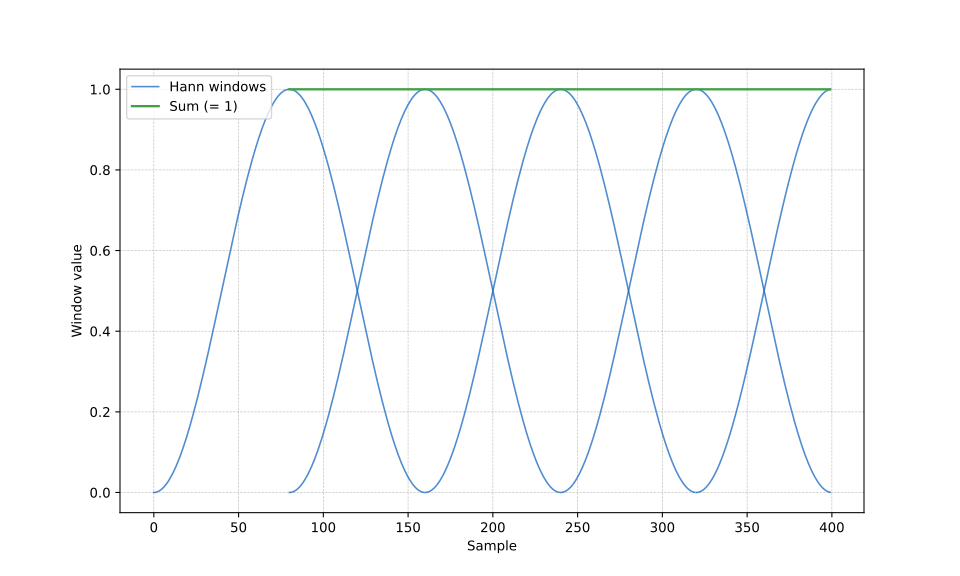
Hann windows at half-width hops sum to one (constant overlap-add), so two alternating grains reconstruct a signal. Granular, OLA, WSOLA and PSOLA scheduling build on this.
The window is a template parameter: any generator constructible from
(duration, sps), with config(duration, sps, bool) and operator()().
hann_gen is the default; blackman_gen and
hamming_gen also qualify. Buffer
reads go through the buffer’s sample_interpolation policy; hermite is
recommended when grains are anchored at sub-sample positions.
Declaration
template <typename Window = hann_gen>
class grain
{
public:

   explicit       grain(float sps);

                  template <typename Buffer>
   float          operator()(Buffer const& buf);

   void           spawn(float delay, std::size_t width);

   bool           active() const;
   float          delay() const;
   std::size_t    remaining() const;
};
Expressions
Notation
W-
A window generator type, e.g.
hann_gen. g_type-
A
grain<W>type. g,a,b-
Objects of type
grain<W>. buf-
A ring buffer indexable with the grain’s delay, where index 0 refers to the newest element (e.g. fractional_ring_buffer).
d-
Floating point value for the delay in samples, possibly fractional.
w-
Object of type
std::size_t: the grain width in samples. sps-
Floating point value for samples per second.
Type Construction
| Expression | Semantics |
|---|---|
|
Instantiate a |
|
Instantiate a |
Constructors and Assignment
| Expression | Semantics |
|---|---|
|
Construct an inactive grain given |
|
Copy construct from |
|
Assign |
| C++ brace initialization may also be used. |
Function Call
| Expression | Semantics | Return Type |
|---|---|---|
|
Get the next windowed sample,
|
|
Call g(buf) exactly once per buffer push: the rate 1 playback comes
from the constant delay riding the buffer’s newest-first indexing.
|
The delay must stay in the buffer’s valid index range for its
interpolation type over the grain’s whole life (see sample_interpolation):
[1, size-3] for hermite.
|
Operation
| Expression | Semantics | Return Type |
|---|---|---|
|
Start the grain, reading at the constant
delay |
|
Accessors
| Expression | Semantics | Return Type |
|---|---|---|
|
Get whether the grain is active. |
|
|
Get the grain’s delay. |
|
|
Get the number of samples left before the grain goes inactive. |
|
Example
Delay the input samples in by 1000 samples into the output samples out,
at sps samples per second, through two grains alternating at half-width
hops:
#include <q/utility/fractional_ring_buffer.hpp>  // For fractional_ring_buffer

namespace q = cycfi::q;

using buffer_type = q::fractional_ring_buffer<
   float, std::vector<float>, double, q::sample_interpolation::hermite>;

auto buf = buffer_type{4096};
auto a = q::grain<>{sps};                                   (1)
auto b = q::grain<>{sps};

for (std::size_t i = 0; i != in.size(); ++i)
{
   buf.push(in[i]);
   if (!a.active())
      a.spawn(1000.0f, 512);                                (2)
   if (i >= 256 && !b.active())
      b.spawn(1000.0f, 512);                                (3)
   out[i] = a(buf) + b(buf);                                (4)
}| 1 | Construct two grains with the default Hann window. |
| 2 | Respawn grain a every 512 samples, reading 1000 samples back. |
| 3 | Respawn grain b every 512 samples, starting 256 samples after a. |
| 4 | Sum the two grains. Their windows overlap by half and sum to one. |