Level Crossfade
Overview
The level crossfade blends two signals, a and b, under the control of a level, ctrl. It is given a pivot, in decibel. While ctrl is at or above the pivot, the output is a alone. Once ctrl drops below the pivot, a fades out and b fades in by ctrl - pivot decibels: the lower ctrl falls, the more of b is heard. The level crossfade is implemented by a class named level_crossfade.
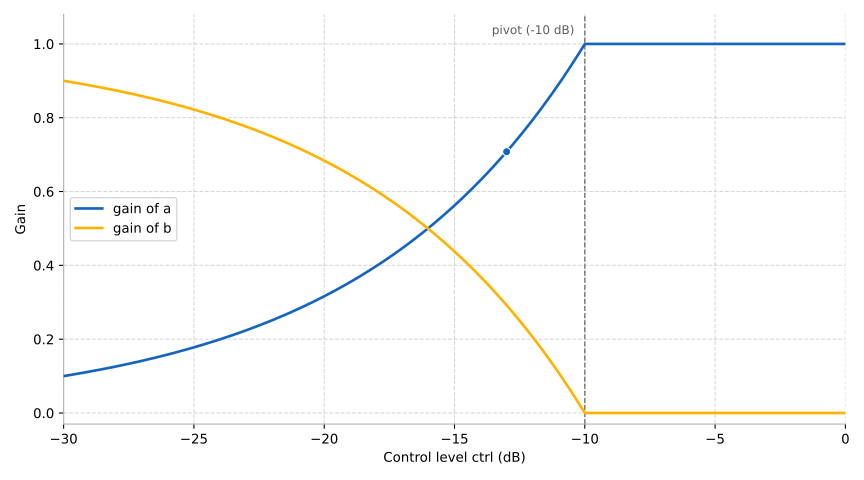
a is 1 and b is silent. Below it, the gain of a follows the (linear) level ctrl - pivot while b takes up the remainder. At ctrl = -13 dB the gain of a is 0.708 (a 3 dB drop).Below the pivot, the gain of a is lin_float(ctrl - pivot), the linear equivalent of the negative decibel gap, and the gain of b is 1 - gain_of_a. The two gains sum to 1. A gap of 0 dB (at the pivot) gives all a; a gap of -3 dB gives 0.708 of a and 0.292 of b; a large gap gives nearly all b.
The typical use is a level-dependent source select: the signal for loud passages in a, the fallback for when the level sags in b, and ctrl from an envelope follower. The pivot can be changed at run time; the constructor is constexpr.
Declaration
struct level_crossfade
{
   constexpr         level_crossfade(decibel pivot);

   float             operator()(float a, float b, decibel ctrl);
   void              pivot(decibel pivot_);
};
Expressions
Constructors and Assignment
| Expression | Semantics |
|---|---|
|
Construct a |
|
Copy construct from |
|
Assign |
| C++ brace initialization may also be used. |
Function Call
| Expression | Semantics | Return Type |
|---|---|---|
|
Process |
|
Example
Below -10 dB, fade from the dry input samples in into a reverb return,
writing the blend to out, at sps samples per second:
#include <q/fx/level_crossfade.hpp>
#include <q/fx/envelope.hpp>      // For peak_envelope_follower
#include <span>
...
namespace q = cycfi::q;
using namespace q::literals;

std::span<float const> wet;         // the reverb return
...
auto xfade = q::level_crossfade{-10_dB};                 (1)
auto env = q::peak_envelope_follower{50_ms, sps};

for (std::size_t i = 0; i != in.size(); ++i)
{
   auto level = q::lin_to_db(env(std::abs(in[i])));
   out[i] = xfade(in[i], wet[i], level);                 (2)
}| 1 | Construct a level crossfade with a pivot of -10 dB. |
| 2 | Blend the dry and wet samples given the level of the dry signal. |